
By: Ainsley Harding
Hi, my name is Ainsley. I am 19 years old and a member of ANN’s Junior Board. I love making friends and doing what normal young adults and teenagers do. I am going into my freshman year of college. I was diagnosed with nystagmus when I was a baby. Nystagmus has been a big part of my life, and it will continue to be a big part of my life. When you have nystagmus, or any other disability, you have to gain confidence with what you are given.
When I was younger, I never knew anybody who had nystagmus. I never thought about being different from anybody else, and when I think about it, I really wasn’t. The only difference was that I saw the world a little differently than most people. When I think about how I gained confidence with my nystagmus, I remember that my parents would always tell me I had “dancing eyes.” I always thought that was the coolest thing. I remember telling my friends and classmates that I had dancing eyes without really knowing what that meant. Growing up, I didn’t really ask a lot of questions about my vision, but I think I started to notice it more when I was placed on an IEP (individual Education Program). I was given tools and accommodations to help me succeed in school. As I got older, my parents encouraged me to be more confident in asking teachers for help. The one thing that made that difficult was that I was very shy, so it was hard for me to step out of my comfort zone. Eventually, as I went through middle school and high school, my confidence started to grow little by little. For some reason, the first day of my junior year felt different. It was like I woke up knowing what to do, and everything felt like an average day. At first, that felt strange because the first day of school had always been nerve-racking for me, even though I had attended the same schools for years and already knew many of the people there.
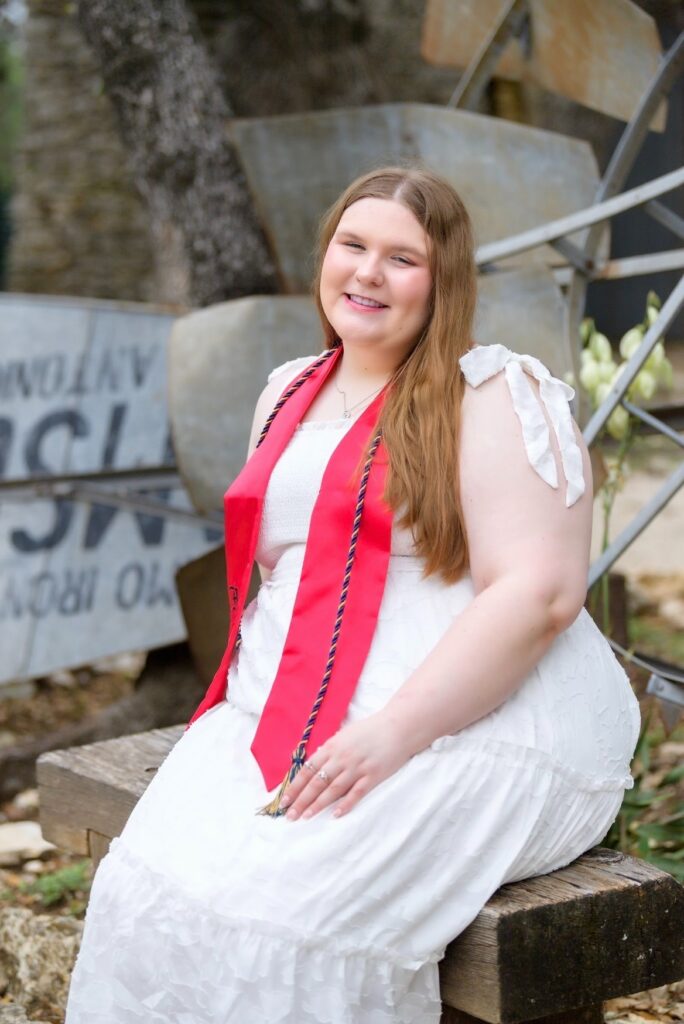
I think what helped me gain that confidence was that I focused more on being a normal kid and teenager rather than treating myself like I wasn’t. My parents, siblings, friends, and their families also treated me like any other kid or teenager. My parents encouraged me to try different hobbies so I could learn from each experience, even if the activity ultimately wasn’t for me. Over the years, I tried gymnastics, dance, tumbling, and cheer. I cheered competitively for five years and later took dance classes at my middle school for three years. When I got to high school, I joined our school’s spirit program. It included pep squad, drill team, dance team, and cheer. During my freshman year, I considered trying out for the cheer team. They only accepted 24 girls, and participants had to be incoming sophomores, juniors, or seniors. In the end, I chose to stay in pep squad, which is where most freshmen start if they want to try out for other spirit teams later on. It’s also an option for students who still want to be involved in school spirit even if they don’t make one of the other teams. I stayed in pep squad for another year and thought about trying out again. However, by the middle of my sophomore year, I was beginning to lose the passion I once had. The activities took up a large part of my schedule, and by the end of the year, I was exhausted. As a result, I decided to leave the program before my junior year. I share this because the people around me never allowed me to use my vision as an excuse not to try something. They encouraged me to pursue the things I wanted to do and to give them my best effort. I learned that if I truly wanted something, all I had to do was set my mind to it and keep going, even when it was difficult.
These experiences are ones I will look back on in the future and see how they shaped me. They helped me grow from someone who was scared to ask a teacher for help into someone who is comfortable asking college professors for advice, guidance, and answers to my questions. This is a mindset that I hope to carry with me into college and continue developing over time as I grow both personally and academically. I hope it will help me achieve my goals, become the person I want to be, and lead me to a history career that I am passionate about after college.